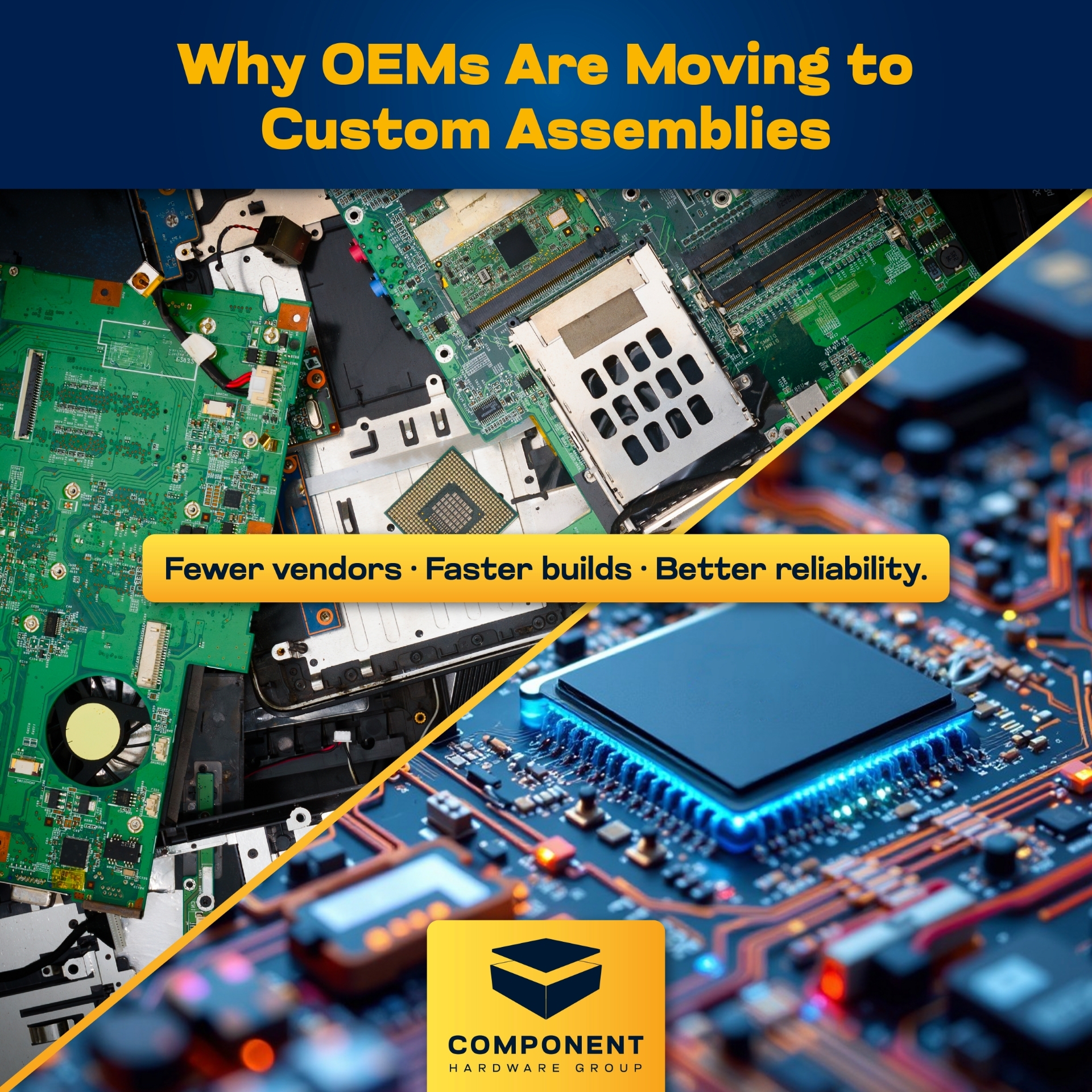
In manufacturing, Original Equipment Manufacturers (OEMs) face mounting pressure to innovate, reduce costs, and deliver high-performing products faster than ever. Meeting these expectations while maintaining quality and compliance is no small feat.
That's why more OEMs are rethinking their approach to product development and supply chain management. And that is by investing in custom assemblies.
Custom assemblies are engineered solutions that integrate multiple components into a tailored, pre-assembled unit, built to match a product's exact specifications and operating environment. Far from being a niche offering, they are becoming a strategic tool that helps OEMs stand out, streamline operations, and scale smarter.
In this article, we explore why OEMs across industries are shifting to custom assemblies and how this decision delivers a measurable competitive advantage.
The Challenges Facing OEMs Today
Let's start by addressing the evolving pressures OEMs face:
- End-users expect more flexibility and product options, pushing OEMs to offer more configurations without sacrificing quality or delivery speed.
- Raw materials, skilled labor, and shipping have all seen price increases. Cost efficiency is more crucial than ever.
- Regulatory standards for safety, performance, and environmental impact are constantly evolving, requiring more precision and documentation.
- Global disruptions, vendor delays, and logistic bottlenecks threaten production timelines and profitability.
Against this backdrop, OEMs are finding that off-the-shelf components often limit their ability to respond quickly or differentiate their offerings. That's where custom assemblies enter the picture.
What Makes Custom Assemblies Strategic?
Unlike standard components, which are designed for broad applications, custom assemblies are built specifically for your system's unique requirements. This specificity is what transforms them from a manufacturing decision into a business strategy.
Here's why:
1. Product Differentiation
OEMs need to deliver both functionality and unique value. Custom assemblies allow manufacturers to integrate features that elevate performance, enhance user experience, and create IP-driven product benefits.
Your products stand apart by designing assemblies that align with your brand's performance standards or use-specific configurations.
2. Streamlined Design and Engineering
Custom assemblies reduce component mismatches and tolerance stack-up by engineering parts that are meant to work together from the start. This reduces design revisions, rework, and time spent troubleshooting integration issues.
The result? Faster development cycles and fewer product delays.
3. Improved Quality and Reliability
Precision-fit assemblies ensure consistent performance, lower failure rates, and reduced wear and tear. Custom engineering minimizes weak points by addressing real-world conditions such as:
- Exposure to moisture or chemicals
- Temperature extremes
- Load-bearing requirements
- Complex motion or force interactions
That level of alignment is simply not achievable with off-the-shelf options.
4. Compliance and Safety Readiness
OEMs in regulated industries must ensure their products meet specific standards. Custom assemblies allow manufacturers to integrate compliance considerations—like NSF, ADA, or FDA regulations—right into the design, avoiding costly rework or certification delays later.
Operational Benefits: Beyond the Product
The benefits of custom assemblies extend far beyond the product itself—they also improve the efficiency of your operation, particularly in areas like procurement, inventory, and production.
1. Fewer Vendors, Simpler Supply Chain
Custom assemblies consolidate multiple parts into a single, turnkey solution. That means fewer suppliers to manage, fewer purchase orders, and fewer variables that can derail production.
This reduces administrative overhead and streamlines communications between engineering and sourcing teams.
2. Better Inventory Management
When you purchase integrated assemblies instead of individual components, you minimize SKUs and reduce the risk of parts being out of sync in your warehouse or production line.
With CHG, for example, you can leverage inventory support in key North American locations, ensuring availability without the burden of overstocking.
3. Reduced Assembly Time and Labor Costs
Pre-assembled units mean your team spends less time on in-house assembly and more time on high-value activities. This improves production flow, shortens lead times, and reduces the chance of assembly errors that could result in returns or recalls.
Why OEMs Choose CHG for Custom Assemblies
At Component Hardware Group (CHG), we work with OEMs to engineer and deliver fully customized assemblies that align with both technical and business goals.
Here’s how we create value:
- Engineering expertise
Our team collaborates with yours to understand technical requirements, environmental conditions, and performance goals.
- Global sourcing
We leverage a network of 100+ factories in 10+ countries to source the right materials at the right price, without compromising quality.
- In-house assembly
We offer local production and sub-assembly services that reduce your labor burden and increase flexibility.
- Inventory on demand
We invest in stocking critical parts so you don't have to, offering fast turnaround and lower carrying costs.
We help OEMs streamline their operations, simplify procurement, and create competitive products that stand the test of time.
Making the Shift: Is Custom Right for You?
It may be time to reevaluate if you're still relying on off-the-shelf components and juggling multiple suppliers for your assemblies.
Ask yourself:
- Are my current components limiting product innovation?
- Is managing multiple vendors slowing my production?
- Could tighter integration improve product quality or reduce defects?
- Am I leaving potential cost savings on the table?
If you answered yes to any of these, custom assemblies might be the smarter business decision.
Final Thoughts: Gain the Edge with Custom Assemblies
In manufacturing, every decision can either push you forward—or hold you back. OEMs that adopt custom assemblies are doing more than solving technical challenges. They’re building smarter, leaner, more agile businesses.
With CHG as your partner, you gain:
- Precision-fit solutions
- Streamlined operations
- Reduced cost and complexity
- Long-term scalability and flexibility
Ready to gain a competitive edge?
Contact CHG today to explore how our custom assemblies can power your next product breakthrough.


