
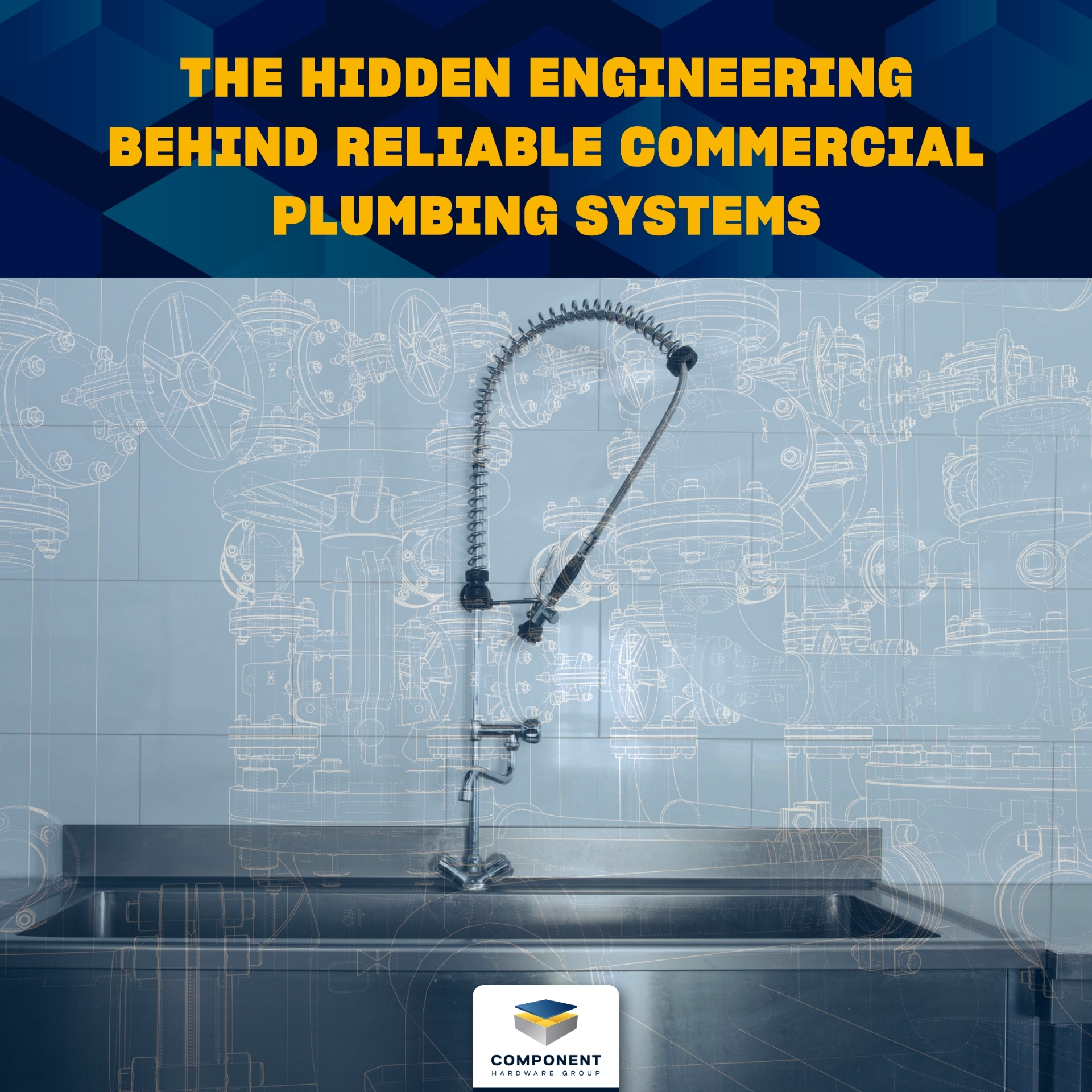
When a restaurant, hospital, or foodservice facility installs new plumbing fixtures, reliability is a must. Behind every faucet, pre-rinse assembly, or valve lies a complex combination of engineering, materials science, and design control that determines how well it will perform under pressure.
What most people don’t realize is that every component inside a commercial plumbing system, from the gasket to the gooseneck, carries an invisible signature of precision engineering.
At Component Hardware Group (CHG), we’ve built reliability into every product line we manufacture, ensuring performance that lasts shift after shift, year after year.
The Demands of Commercial Plumbing Systems
Commercial plumbing systems are designed to endure conditions that residential fixtures never face. In foodservice, hospitality, and healthcare environments, components are exposed to constant heat, pressure, detergents, sanitizers, and mechanical stress.
A single leak or valve failure can halt operations or trigger costly repairs, making durability a mission-critical requirement.
CHG engineers fixtures and assemblies to meet these extreme conditions. We work with Encore® premium plumbing products, designed for high-volume commercial kitchens. Our team also uses Top-Line® economy fixtures that deliver value and dependability in fast-paced environments.
Each is engineered with one goal: to deliver consistent performance, regardless of the challenge.
Material Science: The Foundation of Durability
The reliability of any plumbing component begins with the material used. In commercial-grade fixtures, brass and stainless steel are the undisputed workhorses. But how they’re machined, plated, and sealed is where engineering expertise truly shows.
- Brass provides strength, machinability, and corrosion resistance ideal for valves, fittings, and faucet bodies.
- Stainless steel, particularly 304 and 316 grades, offers superior pitting and chemical resistance for high-sanitization environments.
At CHG, engineers analyze every application before selecting a material or finish.
Encore fixtures, for instance, use commercial-grade chrome plating designed to maintain luster under constant exposure to hot water and cleaning agents, while Top-Line assemblies use cost-optimized alloys tested to withstand industry-standard pressure and temperature cycles.
Even the smallest elements — washers, O-rings, and seals — are chosen for chemical compatibility and long-term elasticity, ensuring the system remains watertight through thousands of on/off cycles.
Flow Dynamics: Balancing Performance and Efficiency
Flow control is the unsung science behind every reliable faucet or pre-rinse unit.
Commercial kitchens demand high rinse power, while healthcare facilities prioritize precision and hygiene. Engineering teams use flow modeling and pressure testing to ensure consistency, efficiency, and safety across use cases.
Encore’s pre-rinse assemblies, for example, are optimized to maintain steady spray pressure at reduced flow rates. This allows operators to conserve water without compromising cleaning power. In both Encore and Top-Line fixtures, flow control components are precision-calibrated to balance performance with water conservation, aligning with modern sustainability standards.
This same approach extends across CHG’s product portfolio: high efficiency where it matters, durability where it counts.
Thermal and Mechanical Resilience
In a commercial environment, plumbing fixtures endure repeated stress from temperature changes, cleaning routines, and heavy use. Handles are turned hundreds of times a day; connections expand and contract with thermal cycling; and exposure to chlorinated cleaners accelerates material fatigue.
CHG engineers model and test these forces early in development using finite element analysis (FEA) and rapid prototyping. This ensures the mechanical integrity of every component, whether it’s a pre-rinse valve in a restaurant or a faucet in a cafeteria setting.
Mounting systems and fasteners are engineered for torsional stability, minimizing leaks and downtime. Every weld, joint, and seam is evaluated for fatigue resistance — because in commercial plumbing, the smallest weakness can become the biggest problem.
Sanitation and Safety by Design
Cleanability is a non-negotiable requirement in foodservice and healthcare facilities. Plumbing fixtures must resist biofilm buildup, allow easy disassembly for cleaning, and prevent backflow contamination.
Encore products are known for their smooth, nonporous surfaces, high-polish finishes, and NSF-compliant components that meet the strictest sanitation standards.
Each faucet and pre-rinse assembly is engineered with minimal joints and crevices, simplifying maintenance and supporting food safety compliance.
Meanwhile, Top-Line fixtures deliver similar sanitary design features at a cost-effective scale. It is ideal for operators balancing performance with budget constraints.
Testing and Compliance: Proven Reliability
The difference between “commercial” and “true commercial grade” is in the testing.
Every CHG component undergoes rigorous evaluation to verify its ability to perform under real-world conditions.
Standard testing includes:
- Hydrostatic and burst pressure testing
- Leak and flow-rate verification
- Cycle and endurance testing (simulating years of use)
- Temperature and corrosion resistance testing
- Finish adhesion and abrasion evaluations
This testing discipline ensures that every faucet, fixture, or custom-engineered assembly performs exactly as designed, and continues to perform reliably for years.
Designed for Maintenance and Longevity
Reliability prevents failure and makes maintenance simple when it's needed.
CHG designs every fixture with ease of service in mind:
- Modular cartridge systems for quick replacements
- Standardized fittings compatible with multiple models
- Accessible seals and gaskets to minimize downtime
Encore’s pre-rinse assemblies, for example, are designed for tool-free cartridge changes, allowing operators to service units on-site without shutting down critical workstations.
This maintainability focus translates to less downtime and lower lifetime cost, a crucial advantage for foodservice operators and OEMs alike.
The Engineering Collaboration Behind the Hardware
Behind every fixture, valve, or assembly is a collaboration between CHG engineers, OEM partners, and quality teams.
CHG’s consultative design process supports customers from concept to production, offering:
- Rapid prototyping and 3D CAD modeling
- Value engineering for cost reduction
- Reverse engineering for legacy components
- Custom sub-assembly integration for OEM applications
This partnership-driven approach allows CHG to deliver hardware that fits seamlessly into a customer’s system, whether it’s a new foodservice line, healthcare equipment, or an industrial wash station.
The Unseen Engineering That Keeps Kitchens Running
When a faucet works flawlessly shift after shift, few people think about the fluid dynamics, seal compression, or metal stress testing that made it possible. But those invisible details are exactly what determine whether a fixture lasts two years or twenty.
CHG’s decades-long investment in engineering excellence ensures that every plumbing product is built to perform reliably under pressure.
That reliability is not just about hardware. It’s about trust, the confidence that every connection, every flow, and every fixture is backed by 44 years of engineering discipline and global manufacturing expertise.
Final Thoughts
Reliability in commercial plumbing isn’t an accident. It’s the outcome of smart design, careful material selection, and relentless testing.
At Component Hardware Group, we engineer every fixture with that philosophy in mind. We balance durability, efficiency, and serviceability to support the world’s most demanding facilities.
Whether it’s an Encore faucet delivering precision and performance, a Top-Line fixture providing everyday value, or a custom OEM assembly built to exact specifications, CHG ensures every component performs when it matters most.
Because in commercial plumbing systems, true reliability starts long before the water flows.


