
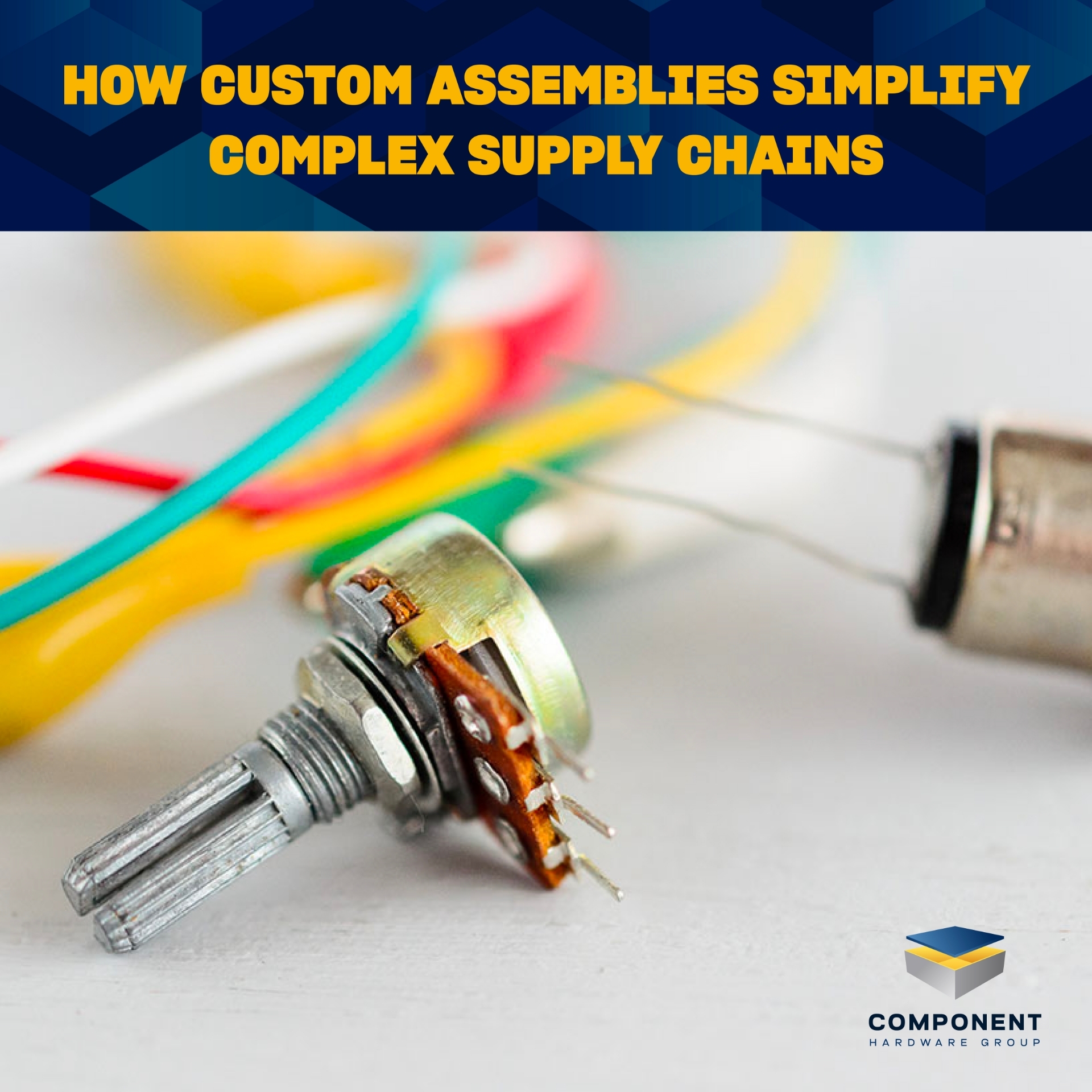
Most supply chain problems do not start as major disruptions.
They start as extra steps, like:
- additional supplier to manage
- another part number to track
- another internal assembly task that seems minor on its own but adds time, coordination, and risk to every build.
Over time, those extra steps pile up. And when they do, the real problem is not just complexity. It is the drag that complexity creates across sourcing, production, and consistency.
That is why more manufacturers are taking a harder look at custom assemblies.
Complexity Has a Cost
When teams discuss supply chain pressure, they often focus on lead times, pricing, and availability. Those issues matter, but another layer of cost arises within the operation itself.
Too many parts can mean more purchasing effort. Too many suppliers can lead to more communication and greater opportunities for disruption. Too many assembly steps can mean more labor, more room for variation, and more chances for something to slow down at the wrong moment.
None of that is dramatic in isolation. Together, they can become a serious obstacle to efficiency.
Why Custom Assemblies Matter
A well-designed custom assembly does more than combine components. It reduces the number of moving pieces your team has to manage.
That can mean fewer sourcing touchpoints, fewer internal assembly steps, and better consistency from one unit to the next. It can also mean that more of the integration work happens before components ever reach your line, which helps reduce friction where time and labor matter most.
For manufacturers trying to improve throughput without creating new headaches, that kind of simplification is valuable.
A Good Example: Wire Harnesses
Wire harnesses are among the clearest examples of how complexity can build quickly.
When wiring is handled through multiple separate components and manual assembly steps, installation takes more effort, and consistency becomes harder to maintain. The result is often more time spent assembling, checking, and troubleshooting.
A more integrated harness solution can help standardize that process.
Simplification Becomes Even More Valuable in Mixed Builds
This becomes especially important in environments where some parts of a project are custom-fabricated while others are sourced through different channels.
In school-related work, for example, fabricators may be building worktables, equipment stands, buffet and serving lines, sinks, hand sinks, and repair assemblies, while cooking and refrigeration equipment is often purchased completely from OEMs through dealers. In that kind of workflow, reducing unnecessary sourcing and assembly complexity can make a meaningful difference.
The goal is not to consolidate everything, but to simplify the parts of the process that are slowing the team down.
Start Where the Friction Is Highest
The best custom assembly opportunities are usually not the ones with the most engineering complexity. They are the ones causing the most operational friction.
- Where are teams spending too much time coordinating parts?
- Where are repetitive assembly steps eating up labor?
- Where does inconsistency show up most often?
- Where would a more integrated solution create immediate relief?
Those are the pressure points worth solving first.
The Bottom Line
Custom assemblies are not just about convenience. They are about making production easier to manage.
When part counts grow, vendors multiply, and assembly steps expand, even a good process can start to slow down. The right assembly strategy helps reduce that drag so teams can spend less time managing complexity and more time moving work forward.
If too many parts, suppliers, and assembly steps are slowing your team down, it may be time to simplify. Talk to CHG about custom assemblies and wire harness solutions to reduce sourcing complexity and keep production moving.


