
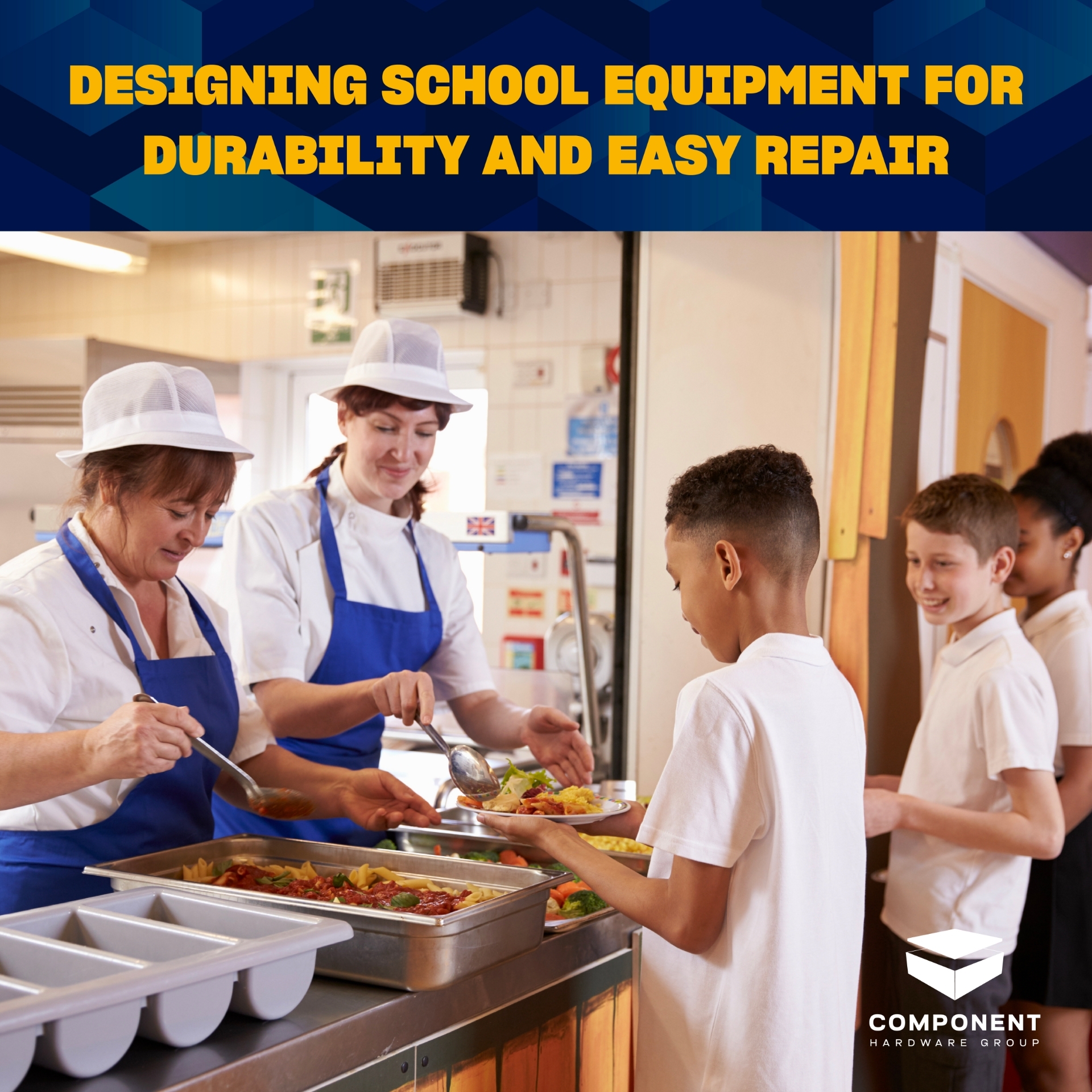
Schools are among the most demanding environments for equipment. Unlike typical commercial spaces, they run on strict schedules, operate on limited budgets, and see heavy daily use. Equipment installed today must work reliably for many years while supporting continuous use.
This is why durable school equipment design is essential.
Across school facilities, especially in cafeteria serving areas and food preparation spaces, equipment must perform reliably day after day. Cabinets, drawers, serving stations, mobile equipment, and sink systems used for cleaning and food preparation are in continuous use throughout the school year.
For OEMs and fabricators working with schools, durability must be built into equipment from the start.
Institutional Environments Present Unique Challenges
School facilities place unique demands on equipment and hardware systems.
These environments often involve:
- High daily usage by large numbers of students
- Limited opportunity for downtime
- Frequent cleaning and sanitation cycles
- Exposure to moisture and heavy handling
- Constrained maintenance staffing
Cafeteria equipment, for example, may operate continuously during meal service while supporting hundreds of students each day. Cabinets, drawers, serving equipment, and sink stations equipped with faucets, pre-rinses, and drains must withstand constant use, cleaning, and exposure to moisture.
Designing durable school equipment begins with understanding these real-world operating conditions.
Designing Beyond Minimum Specifications
A common mistake when designing equipment is selecting components that only meet minimum requirements.
For example:
- Drawer slides designed for light-duty storage may struggle under heavier institutional loads.
- Hinges designed for moderate use may wear faster in high-traffic school environments.
- Equipment supports without corrosion-resistant finishes may degrade quickly under frequent cleaning.
Durable school equipment design requires selecting components with appropriate load ratings, corrosion resistance, and structural strength.
Although higher-quality components may cost slightly more upfront, they often deliver significant long-term savings through improved reliability.
Hardware Components That Support Durable School Equipment
Behind every piece of school equipment are hardware components that support daily operation.
In school cafeterias and foodservice areas, commonly used components include:
- Drawer assemblies used in cabinet systems and storage stations
- Tray rail brackets supporting cafeteria serving lines
- Cash drawers integrated into point-of-sale stations
- LED task lighting illuminating food preparation and serving areas
- Sneeze guard components protecting food displays
- Heavy-duty casters allowing equipment to move for cleaning and maintenance
- Faucets, pre-rinses, and drains used in hand sinks, prep sinks, and scullery sinks to support cleaning, sanitation, and food preparation tasks
Although these components are often small, they play a critical role in the performance and reliability of school equipment.
Choosing durable hardware helps ensure these systems function reliably throughout the school year.
Modular Design Improves Serviceability
Another key principle of durable school equipment design is modularity.
Modular equipment allows individual components to be replaced without disassembling the entire unit.
For example:
- Drawer slides can be replaced independently of cabinet structures.
- Hinges can be serviced without replacing full doors.
- Casters can be swapped without removing entire equipment bases.
When equipment is designed with serviceability in mind, maintenance teams can make quick repairs without disrupting daily operations.
This reduces downtime and helps schools keep equipment operating reliably for longer.
Standardization Simplifies Maintenance
Standardizing hardware across equipment platforms is another effective strategy for improving durability and serviceability.
Using consistent components enables:
- Simplified spare parts inventory
- Faster technician training
- Predictable maintenance procedures
- Easier procurement planning
For schools managing multiple facilities, standardized hardware systems make equipment maintenance much easier across campuses.
CHG supports OEMs and equipment manufacturers by providing a wide catalog of hardware components that help maintain consistency across product lines.
Engineering Collaboration Strengthens Equipment Design
Durability often begins with engineering decisions made early in the design process.
CHG works with OEM engineering teams to support equipment development through:
- CAD and 3D modeling
- Rapid prototyping
- Reverse engineering of legacy components
- Value engineering to balance cost and performance
By collaborating early, teams can ensure that hardware components integrate properly with cabinet systems, serving stations, and equipment structures.
Planning ahead helps avoid redesigns and improves long-term reliability.
Designing for Maintenance Access
Durable school equipment design also considers how easily the equipment can be maintained once installed.
If components are difficult to reach or require full disassembly, maintenance becomes more complex and costly.
Best practices include:
- Accessible mounting points
- Removable panels
- Clear identification of replaceable components
- Logical routing of wiring and plumbing systems
- Minimal reliance on specialized tools
Designing equipment for easy service allows maintenance teams to address issues quickly without interrupting operations.
Summer Is the Time to Build for the Future
Summer provides the most important opportunity for schools to upgrade equipment and improve facilities.
When students leave campus, facility teams have a limited window to replace worn components, install new equipment, and prepare buildings for the upcoming school year.
Many schools take this time to upgrade cafeteria serving areas, cabinet systems, and foodservice equipment.
Installing durable hardware during these upgrades helps ensure that equipment performs reliably when students return.
Summer renovations are the ideal time to build systems designed for long-term performance.
Reliable Supply Supports Long-Term Equipment Performance
Durability is not only about design—it also depends on access to replacement components.
CHG supports customers with a broad range of hardware components used in institutional equipment.
Many components are available in stock for immediate delivery, helping OEMs, fabricators, and contractors maintain production schedules and complete summer renovations on time.
This includes commonly used components across cafeteria equipment, including cabinet hardware, serving line components, and plumbing components such as faucets, pre-rinses, and drains.
Reliable component availability helps ensure that equipment can be serviced and maintained for years after installation.
Contact CHG
Whether you are developing new school equipment or upgrading existing systems, durable hardware plays a key role in long-term performance.
Many components are available in stock for immediate delivery, helping support summer renovation projects and long-term equipment reliability.


